This biography is taken from
Bradley McCoy and Hobbiton.
JRR Tolkien The biography of
Tolkien. all rights belong to him and his page.
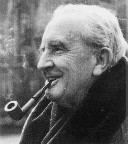 John
Ronald Reuel Tolkien, Eng, born of English parents at Bloemfontein, South
Africa on Jan. 3, 1892 7 died in England on Sept. 2, 1973 in his home at sarehole.
He and his mother moved from africa to sarehole in England were he spent the
rest of his childhood, to which the family returned permenantly in 1896 upon
the death of his father. He educated at King Edward's School, St. Philip's
Grammar School, and later on at Oxford University. After graduating in 1915
he joined the British army were he experienced action in the Battle of the
Somme, two of his closest friends died in battle. He was eventually discharged
after spending most of 1917 in the hospital suffering from "trench fever".
[It was during this time that he began The Book of Lost Tales.]
John
Ronald Reuel Tolkien, Eng, born of English parents at Bloemfontein, South
Africa on Jan. 3, 1892 7 died in England on Sept. 2, 1973 in his home at sarehole.
He and his mother moved from africa to sarehole in England were he spent the
rest of his childhood, to which the family returned permenantly in 1896 upon
the death of his father. He educated at King Edward's School, St. Philip's
Grammar School, and later on at Oxford University. After graduating in 1915
he joined the British army were he experienced action in the Battle of the
Somme, two of his closest friends died in battle. He was eventually discharged
after spending most of 1917 in the hospital suffering from "trench fever".
[It was during this time that he began The Book of Lost Tales.]
Tolkien was a scholar by profession.
His academic positions were: staff member of the New English Dictionary (1918-20);
Reader, later Professor of English Language at Leeds, 1920-25; Rawlinson and
Bosworth Professor of Anglo-Saxon at Oxford (1925-45); and Merton Professor
of English Language and Literature (1945-59). His principal professional focus
was the study of Anglo-Saxon (Old English) and its relation to linguistically
similar languages (Old Norse, Old German, and Gothic), with special emphasis
on the dialects of Mercia, that part of England in which he grew up and lived,
but he was also interested in Middle English, especially the dialect used
in the "Ancrene Wisse" (a twelfth century manuscript probably composed in
western England). Moreover, Tolkien was an expert in the surviving literature
written in these languages. Indeed, his unusual ability to simultaneously
read the texts as linguistic sources and as literature gave him perspective
into both aspects; this was once described as "his unique insight at once
into the language of poetry and the poetry of language" (from the Obituary;
Scholar, p. 13).
From an early age he had been
fascinated by language, particularlythe languages of Northern Europe, both
ancient and modern. From this affinity for language came not only his profession
but also his private hobby, the invention of languages. He was more generally
drawn to the entire "Northern tradition", which inspired him to wide reading
of its myths and epics and of those modern authors who were equally drawn
to it, such as William Morris and George MacDonald. His broad knowledge inevitably
led to the development of various opinions about Myth, its relation to language,
and the importance of Stories, interests which were shared by his friend C.S.
Lewis. All these various perspectives: language, the heroic tradition, and
Myth and Story (and a very real and deeply-held belief in and devotion to
Catholic Christianity) came together with stunning effect in his stories:
first the legends of the Elder Days which served as background to his invented
languages, and later his most famous works, "The Hobbit" and "The Lord of
the Rings".